SCHOOL AUDIT & INSTITUTIONAL PERFORMANCE REVIEW
SQAA Self-Assessment — How It Gates Your CBSE Affiliation Actions
SQAA self-assessment is not a separate compliance task — it is a mandatory gate CBSE checks before processing affiliation, switchover, or upgradation.
Regulatory details last verified: July 2026
What SQAA Actually Is
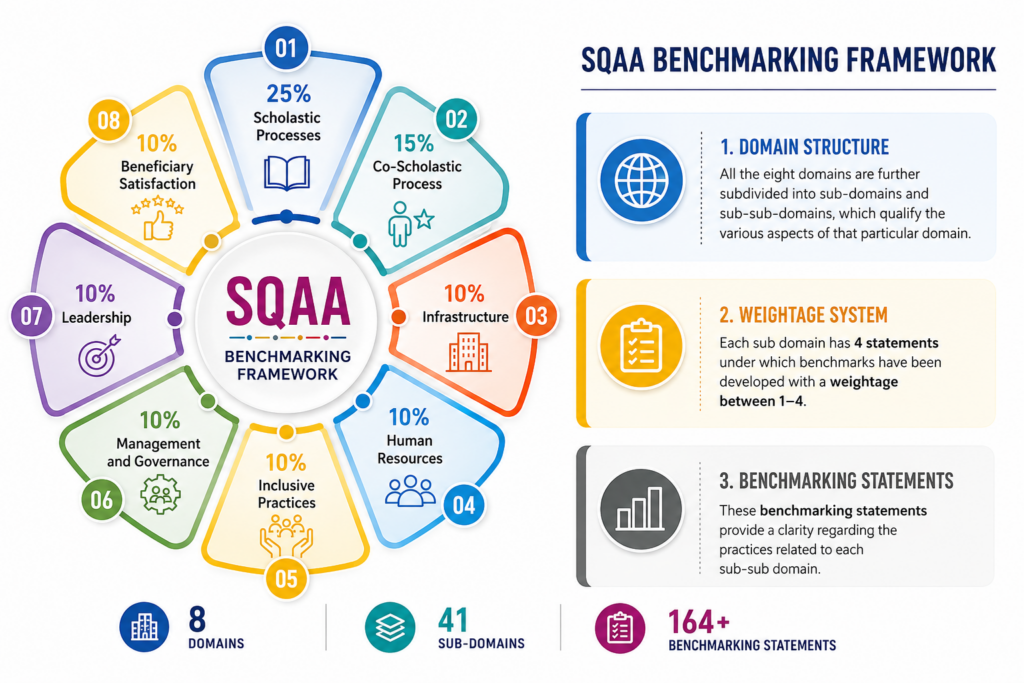
The School Quality Assessment and Assurance (SQAA) Framework is CBSE’s structured self-evaluation mechanism, covering how a school functions across multiple domains — from curriculum delivery to infrastructure to governance.
The Part Most Schools Miss — It Is a Gate, Not Just an Exercise
This is the single most important operational fact about SQAA for a school already thinking about affiliation actions: since the 2023-24 academic year, CBSE will not process any of the following through the SARAS portal until the school has completed SQAA self-assessment:
Fresh Affiliation
New CBSE affiliation applications submitted through SARAS.
Switchover
Moving a school from state board affiliation to CBSE affiliation.
Upgradation
Extending an existing CBSE affiliation to cover higher classes, such as Secondary to Senior Secondary.
Extension
Extending the scope of an existing affiliation, such as adding sections or streams.
This is not a parallel quality initiative — it is a prerequisite step that sits directly in the path of these affiliation actions. A school that treats SQAA as something to get to ‘eventually’ is, in practice, blocking its own ability to act on affiliation plans when the need arises.
How the Self-Assessment Cycle Works
SQAA uses a 4R Quality Cycle: Review, Reflect, Respond, Rate. Schools work through this using a structured Core Learning Team — deliberately not just the principal working alone. The team is meant to include a management representative, the principal, teachers from each level, parent members, student representatives, a co-curricular teacher, a counselor or health professional, and an administrative representative.
Performance is scored against four maturity levels, from Level I (Inceptive — practices are individual-based and not yet systematized) up to Level IV (Dynamic-Evolving — the most mature stage). This is not a pass/fail structure; it is meant to show a school where it currently sits on a developmental continuum, and CBSE has stated explicitly that SQAA does not rank schools against each other.
What Gets Verified, and How
Self-assessment is submitted online. CBSE does not manually verify every submission — instead, a panel reviews a random sample of roughly 5% of applications in each category, and schools selected for this sample are asked to upload supporting documentation for physical quality review. The rest proceed on the strength of the self-assessment itself.
How Eduaccess Helps
Eduaccess helps schools work through SQAA self-assessment not as an isolated compliance task, but as a coordinated part of affiliation planning — ensuring self-assessment is current and complete before it becomes the blocking step in a switchover, upgradation, or extension application.
Led by Mr. Sivaramakrishna Chakkilala — a seasoned Education Leadership Expert with expertise in curriculum development, teacher training, and driving school improvement initiatives — Eduaccess brings the same structured approach to SQAA compliance that it applies across every stage of affiliation and institutional audit work.
Frequently Asked Questions
Do we need to complete SQAA self-assessment even if we are not planning any affiliation changes this year?
If your school anticipates any future affiliation action — switchover, upgradation, or extension — keeping self-assessment current avoids it becoming a blocking step when that need arises, since a lapsed or missing assessment is not something that can be completed instantly.
How many schools actually get their self-assessment physically verified?
Roughly 5% — as covered above, CBSE’s panel reviews a random sample of that size in each category, asking selected schools to upload supporting documentation; the rest proceed on the self-assessment submission alone.
Does a low maturity level rating affect our affiliation status?
SQAA is explicitly not a pass/fail system or a ranking against other schools — it shows where an institution sits on a developmental continuum. That said, since self-assessment must be complete to process affiliation actions, an honest low rating is preferable to an inaccurate one, and improvement planning is itself part of what Level IV maturity looks for.
Who should be on our school's SQAA Core Learning Team?
As covered above, CBSE’s framework calls for a structured team rather than the principal working alone: a management representative, the principal, teachers from each level, parent members, student representatives, a co-curricular teacher, a counselor or health professional, and an administrative representative.