SCHOOL AUDIT & INSTITUTIONAL PERFORMANCE REVIEW
POCSO Compliance Audit — What Inspectors Actually Check
Beyond knowing what POCSO requires — what a compliance audit actually verifies, from documentation to infrastructure to mandatory reporting records.
Regulatory details last verified: July 2026
Beyond Knowing the Law — What Gets Actually Verified
Most schools understand POCSO (Protection of Children from Sexual Offences Act, 2012, strengthened by the 2019 Amendment and the POCSO Rules, 2020) as a legal framework protecting every child under 18. What is less understood is what a compliance audit specifically checks — not whether the school knows the law, but whether it can produce documentation proving the law is being actively followed. That distinction matters, because knowing POCSO and being able to demonstrate compliance to an auditor are two different things.
Documentation an Audit Actually Requests
Background & Police Clearance Records
For every staff member and volunteer with any student contact — the actual records, not a policy stating this happens.
Child Safety Register
An ongoing, maintained log, not a one-time document filed away.
Training Attendance Records
Proof staff actually attended sensitization sessions, not just that a policy requires them to.
Grievance Committee Meeting Minutes
Evidence the committee is functioning on an ongoing basis, not existing only on paper.
Signed Staff Affidavits
Confirming no prior accusation under the POCSO Act for every relevant staff member.
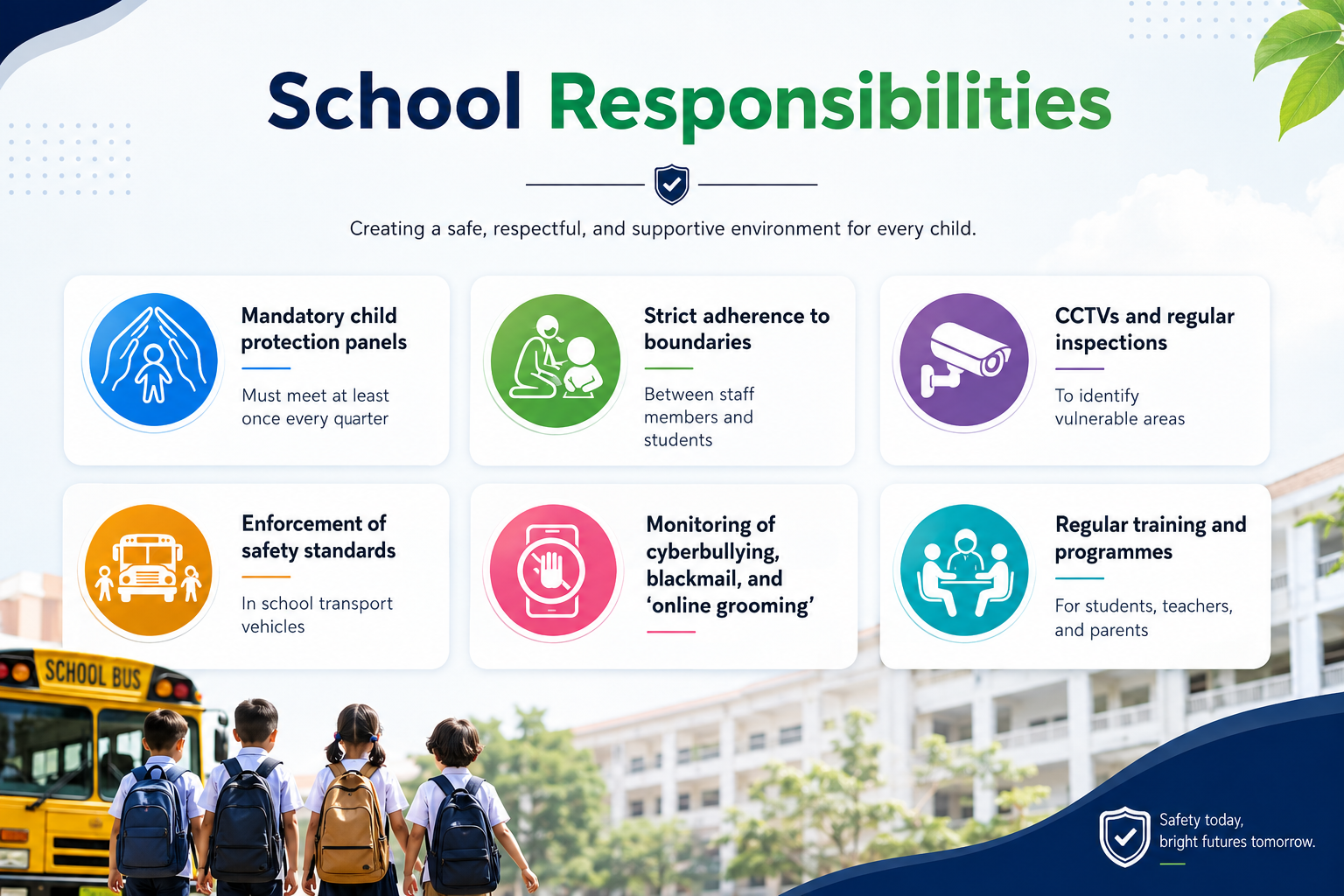
Infrastructure Points an Audit Checks
CCTV Coverage
Appropriate public and common spaces within the premises.
Well-Lit Corridors
No dead-end hallways or staircase hideaways.
Restroom Placement
Located away from isolated areas, not tucked into low-visibility corners.
Displayed Helpline Numbers
Including the national Child Helpline (1098) and local police / SJPU contacts.
Access to the POCSO e-Box
NCPCR's online complaint reporting mechanism.
Mandatory Reporting — Where Institutional Liability Actually Sits
This is the section every school leadership team should read carefully. Under Section 19 of the POCSO Act, anyone — including teachers, and not limited to designated safeguarding staff — who knows or suspects a POCSO offence has occurred is legally obligated to report it. Under Section 21, failure to report is itself a punishable offence: up to six months’ imprisonment or a fine for an individual, and up to one year for a person in charge of an institution specifically. An audit checking mandatory-reporting awareness is not a formality — it is checking whether the institution’s leadership understands they carry personal, not just organizational, exposure here.
How Eduaccess Helps
Eduaccess conducts POCSO compliance audits focused on exactly this documentation-and-infrastructure gap — the difference between a school that knows its POCSO obligations and one that can produce the records an inspector or auditor actually asks for.
Led by Mr. Sivaramakrishna Chakkilala — a seasoned Education Leadership Expert with expertise in curriculum development, teacher training, and driving school improvement initiatives — Eduaccess brings the same evidence-based, documentation-first approach to child safety compliance that it applies across every dimension of institutional audit work.
Frequently Asked Questions
Is having a Child Protection Policy document enough to pass a POCSO compliance check?
No — a policy document alone does not demonstrate compliance. Auditors typically look for the operational evidence behind it: maintained registers, training attendance records, and Grievance Committee minutes showing the policy is actually being followed.
Who specifically carries legal responsibility if a POCSO offence is not reported?
Under Section 19, anyone who knows or suspects an offence — not just designated safeguarding staff — is legally obligated to report it, and under Section 21, both the individual and, separately, a person in charge of the institution can face liability for failure to report.
Does POCSO compliance apply differently to male and female students?
No — POCSO protects every child under 18 regardless of gender; the compliance obligations, documentation, and reporting requirements apply uniformly across all students.
What is the POCSO e-Box?
It’s NCPCR’s online complaint reporting mechanism, referenced above as one of the infrastructure/access points an audit checks that a school has made available.