SCHOOL AUDIT & INSTITUTIONAL PERFORMANCE REVIEW
Why Schools Commission Voluntary Audits
An institutional audit is not just a compliance reaction — here is the actual business case for commissioning one before an inspector makes it mandatory.
Catching Regulatory Drift Before an Inspector Does
Across the boards we advise on, a consistent pattern shows up: schools rarely fail compliance in one dramatic event. They drift into it, gradually and often invisibly from inside the institution. Four patterns account for most of what a formal audit is built to surface:
Staff Turnover
A trained specialist teacher leaves and is replaced by someone without equivalent training — changing your actual staffing readiness from what was last assessed.
Subjects Quietly Discontinued
A declared subject stops being offered due to low enrollment, without formally updating board records — creating a gap between what is on file and what is taught.
Infrastructure Not Maintained
Labs, libraries, or safety equipment that passed inspection years ago age or get repurposed without being maintained to that original standard.
Curriculum Drift
Teaching gradually shifts away from the declared syllabus approach without a deliberate decision to do so — often the hardest drift to notice from inside the institution.
The alternative to catching this proactively is having it caught reactively — at a reapproval visit, an affiliation renewal inspection, or in response to a complaint. A voluntary audit exists specifically to be the version of that discovery that happens on the school’s own timeline, with time to remediate, rather than during someone else’s inspection, with a clock already running.
Supporting Board Affiliation Renewal and Upgradation
This connects to something concrete: CBSE’s own SQAA self-assessment framework functions as a gate, not just a periodic exercise. Since the 2023-24 academic year, CBSE-affiliated schools cannot get any of the following processed through the SARAS portal without first completing SQAA self-assessment:
Fresh Affiliation
New CBSE affiliation applications submitted through SARAS.
Switchover
Moving a school from state board or any other board affiliation to CBSE affiliation.
Upgradation
Upgrading an existing CBSE affiliation to cover higher classes, such as Secondary to Senior Secondary.
Extension of Affiliation
Extending the scope of an existing affiliation, such as adding sections or streams.
An institutional audit that includes SQAA-aligned self-assessment is not a parallel activity to your affiliation plans — it is a prerequisite step for several of the actions above that a growing school will eventually need to take.
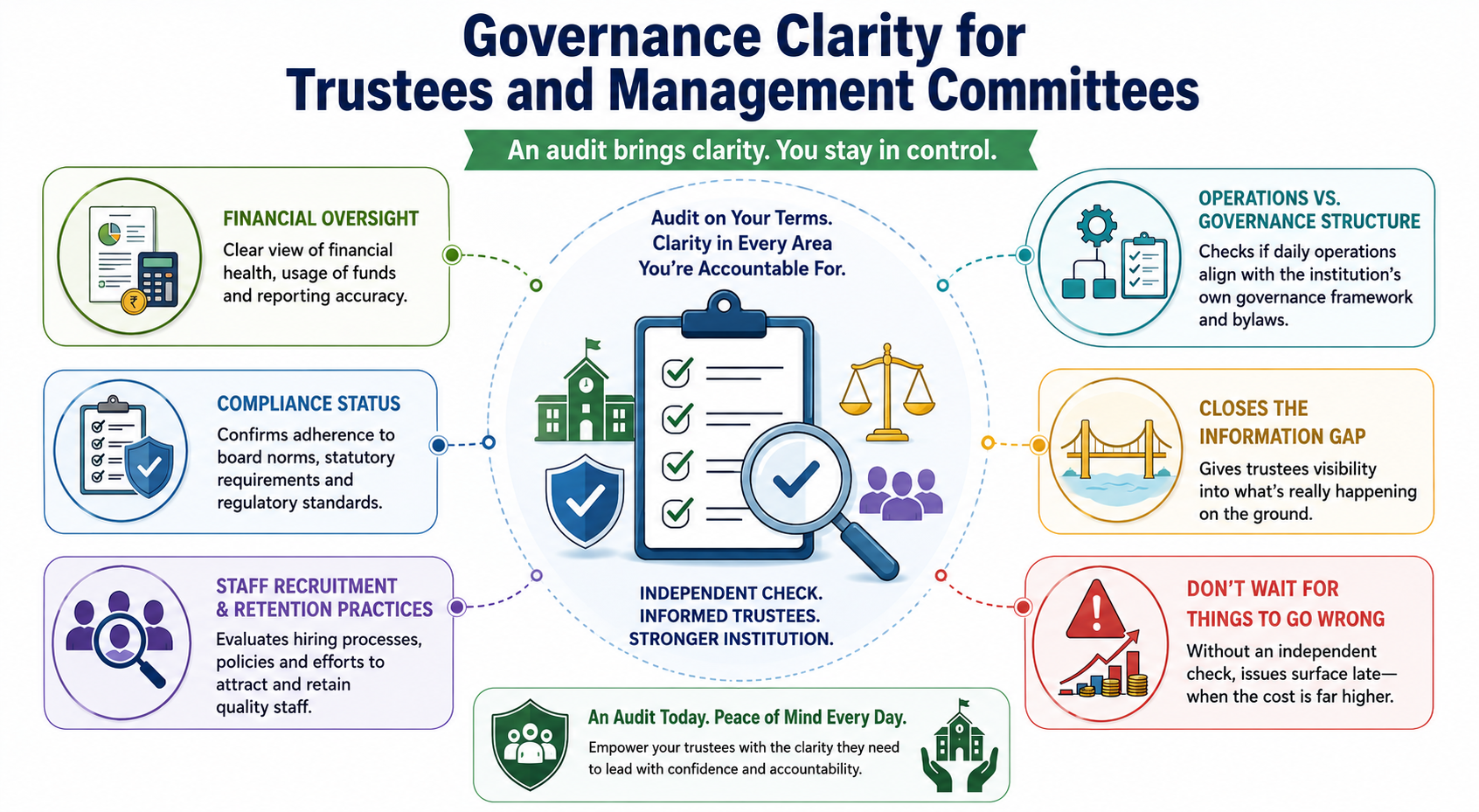
Governance Clarity for Trustees and Management Committees
The audit matters most specifically for a Trust or Society structure, where trustees may hold formal authority but limited visibility into daily operations. An audit closes that information gap on the school’s own schedule, covering exactly the areas trustees are ultimately accountable for: financial oversight, compliance status against board and regulatory requirements, staff recruitment and retention practices, and how closely daily operations track the institution’s own stated governance structure. Without an independent check, this gap typically only surfaces when something has already gone wrong — which is a considerably more expensive way to find out.
What an Audit Does Not Do
In the interest of setting accurate expectations, three things worth being direct about:
Not a Ranking System
Consistent with how SQAA itself explicitly avoids ranking schools, an audit is not a comparative score against other institutions.
Not a Substitute for Board Inspection
An internal or third-party audit does not replace the board's own official inspection process — it prepares the institution for it.
What an audit does provide is an independent, evidence-based picture of where the institution currently stands — the same information a board inspector would eventually form an opinion on, but available to school leadership on their own schedule, with time to act on it.
How Eduaccess Helps
Eduaccess conducts institutional audits across all the dimensions outlined on our School Audit overview page — Pedagogical Effectiveness, Compliance & Documentation, Infrastructure & Resource Adequacy, Governance & Leadership, Staff Management, and Child Safety — with specific attention to how audit findings connect to your board affiliation timeline, since remediation before a renewal inspection is far less costly than remediation after one.
Led by Mr. Sivaramakrishna Chakkilala — a seasoned Education Leadership Expert with expertise in curriculum development, teacher training, and driving school improvement initiatives — Eduaccess brings the same evidence-based approach to institutional audits that it applies across every stage of school establishment and affiliation.
Frequently Asked Questions
Is a school audit only necessary if we are already facing a compliance issue?
No — the most valuable audits happen before an issue becomes visible to a board inspector, since remediation on the school’s own timeline is far less disruptive than remediation under inspection pressure.
Does completing an internal audit affect our official CBSE SQAA self-assessment requirement?
No — an internal audit and CBSE’s official SQAA self-assessment are separate processes. An internal audit can inform and strengthen your SQAA submission, but it does not replace the requirement to complete self-assessment directly on the SARAS portal.
Can an audit rank or certify our school the way SQAA does?
No — as covered above, an audit is not a ranking or certification system. It provides an independent evidence-based picture of institutional standing, not a comparative score or official certification.
Who typically requests these audits — the principal, or the management or trust?
Both, depending on the school’s structure — principals commission audits to get an operational readiness picture, while trustees and management committees commission them for independent oversight of governance, finance, and compliance.